
The Origin
Three stories. One origin.
Leonardome nace de una fascinación compartida por la belleza de las formas, la inteligencia de las estructuras y el deseo de hacerlas accesibles a todo el mundo.
Este proyecto se nutre de tres historias interconectadas: la visión de Leonardo da Vinci, la perspectiva contemporánea de Rinus Roelofs y la colaboración entre el MMACA y Milanta Patis Vius para darle vida.
Con una sola pieza, tendemos un puente entre el pasado, el presente… ¡y el aprendizaje del futuro!
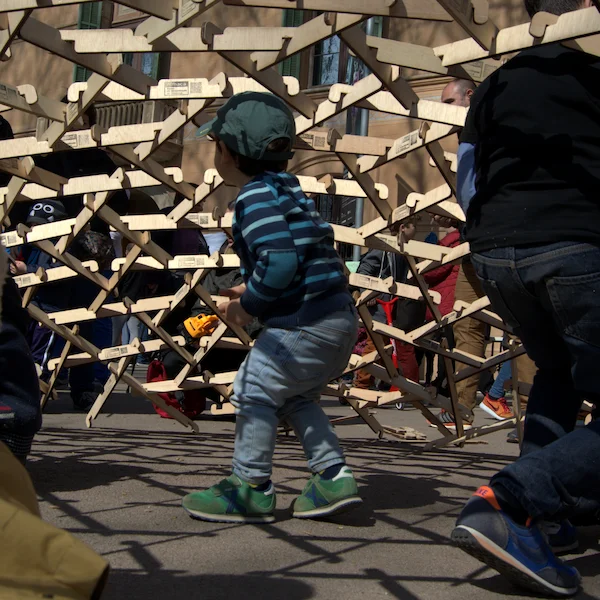
The origin of Leonardome
Learning with hands, head and heart
An educational experience born from a fascination with two brilliant minds.
Leonardome was born from the desire to turn brilliant ideas into educational experiences.
And it is much more than a construction activity. It is a living tribute to two perspectives that, separated by centuries, share the same essence: curiosity, creativity and the desire to understand the world through form:
Leonardo da Vinci, the great genius of the Renaissance, imagined self-supporting structures made from repeated pieces.
Rinus Roelofs, a contemporary sculptor and mathematician, has reinterpreted these forms through art and mathematics, taking them into the realm of experimentation and creation.
Both teach us that understanding and transformation are the seeds of learning.
A collaboration between MMACA and Milanta
Our fascination with these two geniuses led us to design an open, hands-on and collaborative tool to bring all this knowledge to schools, museums, families and organisations.
MMACA’s meticulous research and Milanta’s experience in designing and manufacturing wooden educational materials made the magic possible!
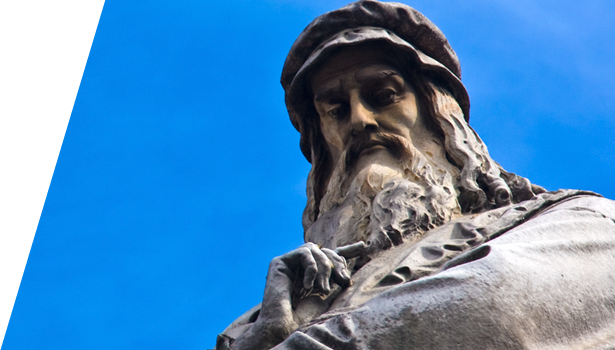
Leonardo Da Vinci (1452–1519)
“Wisdom is the daughter of experience.” — Leonardo da Vinci
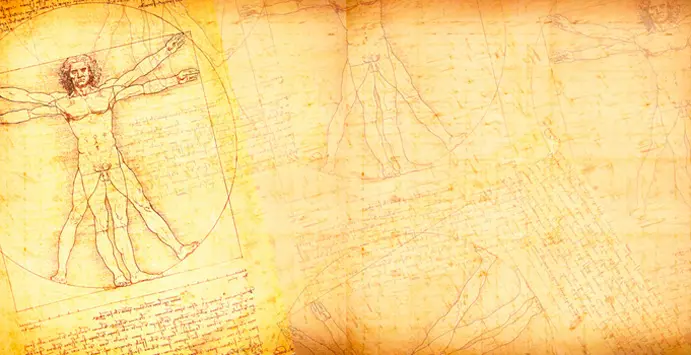
The genius who sought unity between art, science and nature.
Leonardo da Vinci is considered one of the most brilliant figures of the Renaissance, a universal reference for interdisciplinary knowledge and, above all, a passionate observer and tireless experimenter.
Although his painted work is brilliant but scarce, Leonardo’s legacy is immense.
More than 6,000 pages of his manuscripts have been preserved, containing studies in areas as diverse as anatomy, mechanics, engineering, geometry, optics, art and even urban planning. In many of these disciplines, his knowledge anticipated the advances of modern science.
The Codex Atlanticus: Leonardo’s key
The Codex Atlanticus is a collection of 1,119 folios containing Leonardo’s drawings and notes. It reflects his passionate interest in mechanics, architecture, anatomy and perspective, and includes machine designs, urban planning projects for cities such as Milan and Florence, studies of light and shadow and a wide range of technological projects.
It is in this famous codex that Leonardo draws the constructive principle that inspires Leonardome: the mutual support of identical pieces to build domes and bridges without any connecting element.
Folio 71v preserves one of the few diagrams of this kind: a bridge made with sticks that support themselves through geometry.
This concept, now known as a reciprocal frame, is based on mutual three-dimensional support between elements. It is an ancestral system, traditionally used in Eastern architecture, but Leonardo rethinks and studies it from a scientific and mechanical perspective.
Leonardo and geometry: much more than drawings
Leonardo da Vinci was not a theoretical mathematician in the traditional sense, but his genius lay in his ability to integrate mathematics as an essential tool for art, engineering and understanding the natural world.
Leonardo was fascinated by geometry and proportion; for example, in his work the Vitruvian Man, he brilliantly combines two geometric figures, the circle and the square, with the proportions of the human body.
He masterfully applied linear perspective to his paintings, and his studies of how light interacts with different surfaces allowed him to give his works the illusion of depth and realism.
Leonardo always worked from observation, experimentation and the formulation of general principles. He sought precision and quantification in his studies of anatomy, optics, hydrodynamics, friction and many other disciplines, using mathematics as a language to describe natural phenomena.
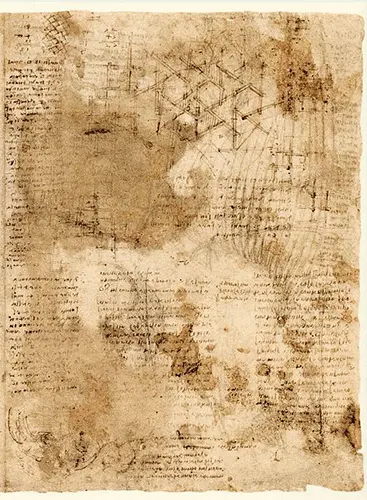
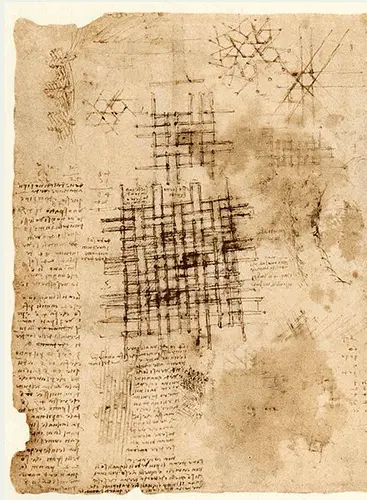
In the images, folios 899v and 899r of the Codex Atlanticus. Link
Rinus Roelofs
Mathematics as artistic inspiration
Rinus Roelofs is a Dutch artist and mathematician whose work continues the humanist spirit of the Renaissance. Specialising in geometric sculpture, his creations sit between the worlds of art and science, captivating both the general public and academics around the world.
Roelofs does not simply create sculptures; he explores, researches and transforms mathematical patterns into tangible and beautiful forms. His visual language is born from observing nature, modular systems, symmetries and repetitions.
He has worked with wood, metal, acrylic and paper, and has created surprising structures that seem impossible… but work with absolute precision!
A contemporary view of Leonardo
Roelofs, in his search for sculptures made from interwoven elements, sensed, as a deep connoisseur of Leonardo’s work, that traces of this idea must inevitably appear in Leonardo’s own creations.
For this reason, he methodically combed through the chaos of Leonardo’s writings until he found drawings of geometric patterns made with logs that had previously gone unnoticed.
From them, using the idea of mutually supporting stick structures, he studied both the full variety of possible geometric patterns and replaced Leonardo’s heavy cylindrical logs with thin, lightweight wooden pieces that could be handled easily.
Art, science and curiosity
Roelofs starts from a simple but powerful premise:
“Mathematical structures are everywhere. We see them every day, but often do not realise that we are looking at mathematics.”
This perspective is the starting point of his work: seeing, being surprised, asking questions and creating. As he says, “the process begins with surprise, continues with understanding and leads to creation.” It is a process deeply connected to Leonardo da Vinci’s.
Some have compared him to M. C. Escher, but Roelofs brings a more structural, sculptural and three-dimensional dimension. His work reminds us that mathematics is not only an abstract science, but an inexhaustible source of beauty, play and possibilities.
Past, present and future
Leonardome inherits this double inspiration: Leonardo’s visionary dream and Roelofs’ exploratory gaze.
With a single piece, a bridge is built between the past, the present… and the learning of the future.
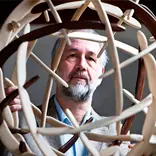
“My work is fascinated by mathematical structures.”
Rinus Roelofs
Enric Brasó i Joan Alborch
The synergy that made Leonardome possible
In his search for new hands-on educational materials for the Museum of Mathematics of Catalonia, Enric Brasó, vice-president of MMACA, came across a photograph of Rinus Roelofs’ domes. That image became the starting point for his own research, which led him to rediscover the same geometric patterns explored by the Dutch artist.
The next challenge was to turn that idea into a physical material with educational and commercial viability. That is when Joan Alborch, founder of Milanta Patis Vius, came into the picture. With enthusiasm, experience and practical vision, he managed to transform the concept into a durable, safe and affordable material for educational and cultural use.
In this way, the experience of raising Leonardo’s domes moved from the experimental sphere to a pedagogical and playful proposal accessible to everyone.
It is also important to highlight the generosity of Rinus Roelofs, who, after learning about Leonardome’s development by MMACA and Milanta Patis Vius, established a warm collaboration and a friendship that continues to this day.
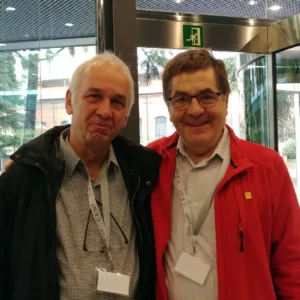
Rinus Roelofs and Enric Brasó